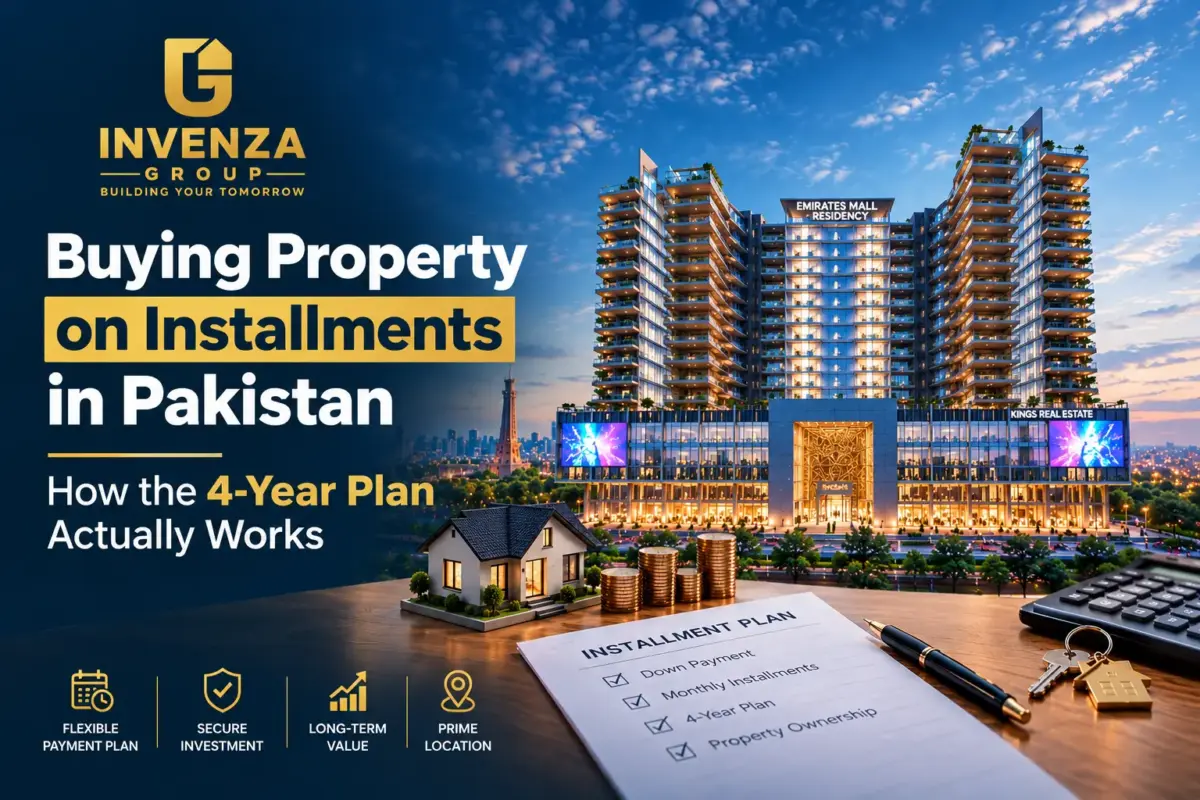
The 4-year installment plan is the standard way Pakistanis buy under-construction property in Lahore. The total price splits across five phases: a booking payment on day one, a confirmation payment within 30 days, 48 small monthly installments, 8 big bi-annual lump sums, and a final possession payment at handover. The percentages vary between developers, but the shape stays the same. This guide decodes each phase, walks a real Emirates Mall & Residency example at Kings Developments’ September 2026 rates, and gives you the exact questions to ask before you sign.
The Real Questions
You’ve decided to buy a Lahore property. The brochure shows a sticker price, say PKR 4.67 million for a small shop or PKR 6.82 million for a studio. Then someone tells you “no problem, you can pay over 4 years on installments.” The next questions in your head are practical:
- What’s my actual monthly outflow going to be?
- What are these “bi-annual” payments and how big are they?
- How much do I need upfront just to book the unit?
- What if my income drops in year 2 — can I pause?
- Can I sell the file before possession if I need the cash back?
- What happens if I miss a payment?
The brochure won’t answer these. Salespeople won’t always be honest about the bi-annuals. This guide gives you the plain-language answers before you commit.
What “Installment Plan” Actually Means in Pakistan
In Pakistan, an installment plan for property means you pay a small percentage upfront to reserve a unit, then spread the balance across a fixed period, usually 4 years; through a mix of monthly installments, bi-annual lump sums, and a final payment at handover.
This is not a mortgage. There’s no bank involved, no interest rate, no down-payment approval process. The transaction is directly between you and the developer. The developer holds your unit reserved from day one; you owe them the balance over the plan’s tenure. Simpler than a mortgage, but the cash-flow discipline is entirely on you.
Ownership transfers only at possession, the moment the developer hands you keys. Until then, what you own is a booking file, which you can sell to another buyer through the developer’s file-transfer process. That flexibility is one of the reasons installment property attracts short-term flippers as well as long-term investors.
The Universal 4-Year Plan Structure
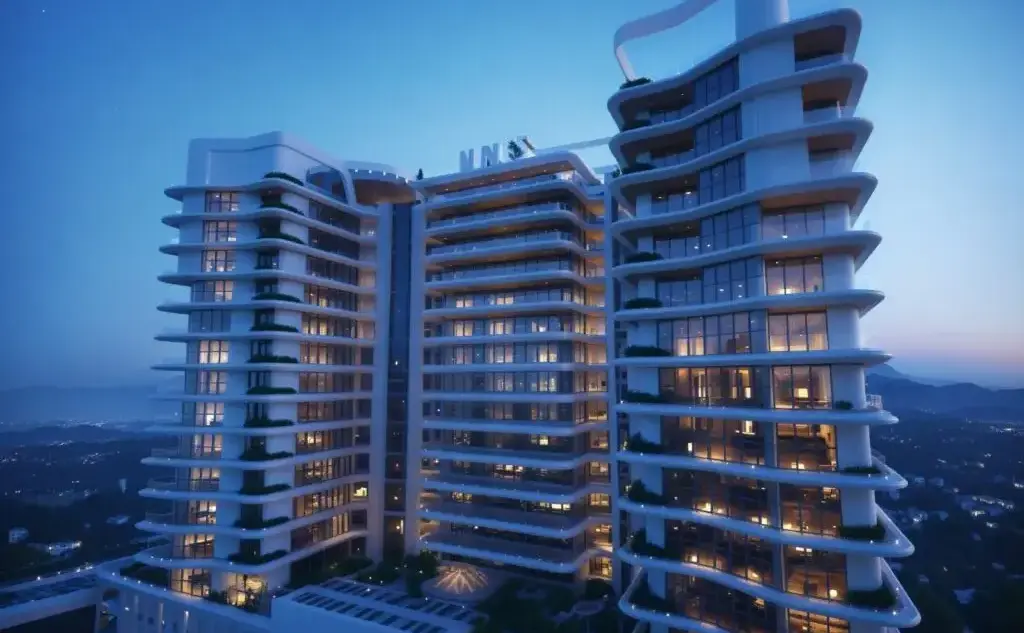
Most Lahore developers in 2026 use a variation of the same five-phase structure. The one Kings Developments uses at Emirates Mall & Residency is representative:
| Phase | % of Total | When It’s Paid |
| Booking | 10% | On the day you book |
| Confirmation | 10% | Within 30 days of booking |
| Monthly Installments | 25% | Spread across 48 months (12 × 4 years) |
| Bi-Annual Installments | 40% | 8 lump sums, one every 6 months for 4 years |
| Possession | 15% | On handover / at possession |
That reads as “10-10-25-40-15” on developer sheets. The percentages shift slightly between projects — some developers run 15-10-25-35-15, others use 5-15-30-35-15. The five-phase structure stays the same: booking + confirmation upfront, then a small monthly drip, plus big bi-annual lump sums, plus a final payment at possession.
Decoding Each Phase
1. Booking (10%)
This is the deposit that reserves your unit. Paid in cash, cheque, or via Roshan Digital Account for overseas buyers. Once the developer receives it, your file is opened and the unit is off the market. Typically non-refundable if you back out — read the booking agreement before signing.
Emirates Mall example: A PKR 4,672,000 second-floor shop needs PKR 467,200 to book.
2. Confirmation (10%)
Also called the “confirmation installment.” Due within 30 days of booking. Its job is to filter out non-serious buyers. Miss confirmation and the developer can cancel your file, most refund the booking minus admin charges, but not all.
Emirates Mall example: Another PKR 467,200 due within 30 days. By day 30, you’ve paid 20%, PKR 934,400 — on that PKR 4.67M shop.
3. Monthly Installments (25% spread over 48 months)
25% of the total price divided across 48 months. This is the smallest recurring commitment and the number salespeople quote first, because it looks manageable.
Emirates Mall example: 25% of PKR 4,672,000 = PKR 1,168,000. Divided by 48 = PKR 24,333 per month.
If PKR 24,333 monthly sounds affordable, remember it’s only one piece of what you’re actually paying. The bi-annuals sit on top of it.
4. Bi-Annual Installments (40% spread over 8 payments)
Every six months, a big lump sum comes due. This is where most buyers get caught off-guard, the monthly looks easy, but the bi-annual bites.
Emirates Mall example: 40% of PKR 4,672,000 = PKR 1,868,800. Divided by 8 = PKR 233,600 every six months.
That’s nearly ten times your monthly installment. Every six months. Eight times over the life of the plan.
5. Possession (15%)
The final 15% is due on handover, typically in year 4. Some developers ask for it slightly before possession as a “pre-possession installment.” Others let you pay on the day you collect keys.
Emirates Mall example: 15% of PKR 4,672,000 = PKR 700,800 at possession.

A Real Emirates Mall Example — Full Year-by-Year Cash Flow
Let’s walk through a 146 sqft second-floor shop at Emirates Mall & Residency at PKR 32,000 per sqft.
Total price: PKR 4,672,000
| Year | What You Pay | Total Outflow |
| Day 1 | Booking 10% | PKR 467,200 |
| Day 30 | Confirmation 10% | PKR 467,200 |
| Year 1 | 12 monthlies (PKR 24,333) + 2 bi-annuals (PKR 233,600) | PKR 759,196 |
| Year 2 | 12 monthlies + 2 bi-annuals | PKR 759,196 |
| Year 3 | 12 monthlies + 2 bi-annuals | PKR 759,196 |
| Year 4 | 12 monthlies + 2 bi-annuals + Possession (PKR 700,800) | PKR 1,459,996 |
| Total | Full 4-year plan | PKR 4,672,000 |
The bi-annuals are the shock. A buyer looking at “PKR 24,333 monthly” and thinking “I can afford that” needs to also plan for PKR 233,600 twice a year, an extra PKR 467,200 per year in lump sums, on top of the PKR 292,000 per year in monthlies.
The Bi-Annual Trap Most Buyers Underestimate
The single most common mistake first-time property buyers make in Pakistan is treating the monthly installment as the “real” cost and the bi-annual as “we’ll figure it out when it comes.”
Do the math on the Emirates Mall example:
- Monthly installment: PKR 24,333
- Bi-annual spread across 6 months: PKR 233,600 ÷ 6 = PKR 38,933 per month
Real monthly cost when you account for bi-annuals: PKR 24,333 + PKR 38,933 = PKR 63,266 per month.
That’s the number your actual cash flow needs to handle, not the PKR 24,333 the salesperson quotes.
If you’re salaried, either save PKR 38,933 every month into a separate account you don’t touch, or make sure your business or family income can absorb PKR 233,600 twice a year without disrupting your other commitments. Skip this math and the second-year bi-annual will feel like a crisis when it lands.

What Varies Between Projects — The Exceptions
The 4-year plan is standard. The specifics aren’t. Here’s what to check before assuming the numbers are typical.
1. Booking percentage can jump
Most units run 10% booking. Some don’t. Kings Developments’ Ground Floor Kiosks at Emirates Mall require 20% at booking; PKR 504,000 upfront on a PKR 2,520,000 kiosk instead of the PKR 252,000 you’d expect. This is on the developer’s own sheet, not a broker markup. If you’re looking at a kiosk or a premium unit, ask specifically about booking percentage before you assume it’s 10%.
2. Bi-annual vs 8-quarterly split
On some units, Kings Developments offers an “8-quarterly” alternative to bi-annuals: instead of PKR 233,600 every six months, you pay PKR 116,800 every three months. Same total, less cash-flow shock. Ask if it’s available on your specific unit.
3. Confirmation timing varies
Some developers give you 30 days for confirmation. Others give 15. A few give 60. Read your booking form, this is a common cause of first-week cancellations.
4. Location charges are separate
“MB / Corner / Courtyard” premiums (typically 5-10% of the base price) are usually paid alongside the payment plan, not as separate additional installments. Confirm this on your quotation.
What Happens If You Miss a Payment
Every developer has a default clause. What varies is how much runway you get before things get serious.
Standard sequence at most Lahore developers
- First late payment: 15-30 days grace period, a written reminder, sometimes a small late fee (PKR 500-2,000).
- Second missed installment in a row: formal notice, larger late fee (typically 5% of the missed amount).
- Third missed installment: the developer starts the cancellation process. This usually includes a final 30-90 day notice period. If you don’t clear arrears in that window, the booking is cancelled.
- Cancellation refund: different developers refund different amounts. Some return 70-80% of what you paid minus admin charges. Some only 50%. Some withhold everything on premium units.
Read the cancellation clause in your booking form before you sign, not after you miss a payment. This is the single most important paragraph in the entire document.
If you know you’re going to miss a payment
Call the developer’s finance office before the due date, not after. Every established developer has an “installment restructuring” desk that can defer one or two payments to the end of the plan without triggering the default clause. This won’t help if you’re perpetually short, but it protects you if you have a one-time cash-flow shock.
Can You Sell the File Before Possession?
Yes. This is called a “file transfer” or “resale on file.”
Once you’ve paid at least the booking and confirmation (20% total), your file becomes transferable. You find a buyer, through a broker or the developer’s resale desk, the buyer pays you an agreed price for the file (your paid amount plus a premium if the project has appreciated, or minus a discount if it hasn’t), and the developer transfers the file to their name for a fixed fee.
Transfer fees (Lahore, 2026 benchmarks)
- Kings Developments: 2% of unit price
- Most established Lahore developers: 1.5-3% of unit price
What sells fastest on secondary
- Small kiosks and shops (PKR 2-5M tickets): usually flip in 30-60 days
- Studios and one-bed apartments (PKR 6-10M): 45-90 days
- Larger shops and two-bed apartments (PKR 15-25M): 90-180 days
- Premium units (three-beds, MB/Corner shops): 6+ months
The smaller the ticket, the wider your resale pool. That’s why kiosks and studios flip fast, more buyers can afford them. A PKR 25M three-bed sits longer because the buyer pool is smaller.
Which Plan Fits Which Cash Flow
Different plan structures suit different income patterns. Match yours to the right one.
1. Salaried professional with steady monthly income
The standard 10-10-25-40-15 works, but you need a savings discipline for the bi-annuals. Set up a separate bank account, deposit PKR 38,933 (or whatever your bi-annual ÷ 6 is) every month, and treat that account as untouchable. The bi-annual becomes a scheduled withdrawal instead of a scramble.
2. Business owner with lumpy income
The bi-annual plan actually fits you better than a mortgage would. Big cash inflows twice a year (Ramzan-Eid business cycle, tax-season client payments, seasonal contracts) line up with the bi-annual schedule. Ask about the 8-quarterly option if you want smoother pacing.
3. Freelancer or consultant with unpredictable months
The monthly installment feels manageable but the bi-annual will hurt in a slow six months. Look for developers offering the 8-quarterly option; PKR 116,800 every three months is easier to save toward than PKR 233,600 every six.
4. Overseas Pakistani with quarterly remittance
Bi-annual installments align badly with quarterly remittance patterns. Ask if the developer accepts an 8-quarterly plan instead. Kings Developments does this on some Emirates Mall units. Match your payment cadence to your income cadence.
Overseas Buyers — Same Plan, Different Mechanics
Overseas Pakistanis pay through a Roshan Digital Account (RDA) or a designated Pakistani bank account. The plan structure is identical. The mechanics have wrinkles worth planning for:
- All payments via RDA — for tax treatment and easier repatriation of eventual rental income.
- Power of Attorney if you can’t fly for the booking signing, around PKR 25,000-50,000 through a Pakistani lawyer.
- Currency risk — you’re paying in PKR but earning in dirham, dollar, riyal or pound. Bi-annuals are big enough that a rate move matters. Some overseas buyers pre-buy PKR for the next bi-annual when the rate is favourable.
- Verify RDA acceptance before signing — most established Lahore developers accept it, but confirm it’s on the booking form.
Real Buyer Questions
Q. Is there any interest on the installment plan?
No. Pakistani developer installment plans don’t charge interest. The total you pay across 4 years equals the sticker price on day one. This is one of the reasons the structure is popular with Muslim buyers — no riba involved.
Q. What if property prices rise while I’m still paying? Do my installments go up?
No. Your total price is locked at booking. If the developer raises rates for new buyers next month, your existing plan doesn’t change. This is one of the strongest reasons to book early on a project you believe in.
Q. What if the project gets delayed beyond 4 years?
The installment schedule usually continues on its original timeline until you’re close to the 4-year mark. If possession is delayed beyond that, most developers pause the final possession installment until handover. Confirm this clause in your booking form.
Q. Can I pay off the plan early and get a discount?
Yes, on most projects. Kings Developments and several other established Lahore developers offer a 5-10% discount for full cash purchase or accelerated payment (settling 60% within year 1, for example). Ask specifically — the discount isn’t always advertised.
Q. Do I pay tax on the property while I’m still on the installment plan?
Property tax typically doesn’t apply until possession. But CVT (Capital Value Tax) and stamp duty are paid at booking on the total price. Overseas buyers using RDA get certain tax exemptions — confirm with your tax advisor before booking.
Q. Can I switch from bi-annual to monthly mid-plan?
Usually no. The plan you sign for is the plan you’re on. Some developers allow a one-time restructuring if requested at year 2, but it’s not guaranteed. Pick the right plan at booking.
Q. What documents do I need to book?
CNIC (both sides), one recent passport photo, proof of income (bank statement or salary slip), NTN if you’re a business owner, and the booking amount in the developer’s accepted form (usually cheque or bank transfer). Overseas buyers additionally need passport copies and RDA account details.
Q. How much do I actually need in the bank to book?
For a PKR 5M unit: PKR 500,000 booking + PKR 500,000 confirmation within 30 days = PKR 1M readily available in month 1. For a PKR 10M unit: PKR 2M readily available. Plus your first bi-annual (roughly 5% of price) six months later.
Q. What if the developer goes bankrupt?
This is the LDA-approval question. LDA-approved projects have escrow-like protections and clearer refund pathways if the developer defaults. Non-approved projects don’t. This is the single biggest reason to only book LDA-approved projects, regardless of how attractive the payment plan looks.
Q. Can I use a bank loan to pay the installments?
Not commonly. Most Pakistani banks don’t offer under-construction property loans — they lend against fully constructed, titled units. If you need financing post-possession, some developers have partnerships with Islamic banks offering diminishing musharaka arrangements.
Q. What’s the smallest unit I can book on a 4-year plan?
Depends on the project. At Emirates Mall & Residency, the entry point is a 56 sqft Ground Floor kiosk at PKR 2.52M. Studios start at PKR 6.82M. Different projects have different minimums.

What About 5-Year, 6-Year or Cash Plans?
The 4-year plan is standard but not universal.
1. 5-year and 6-year plans
Some Lahore developers offer 5-year or 6-year variants on larger units. Structure stays similar (booking + confirmation + monthlies + bi-annuals + possession), but the bi-annuals shrink because they’re spread across more payments. Trade-off: you pay for longer, and the developer may attach a small “extended tenure” premium to the total price.
2. Full cash purchase
Paying full cash at booking usually earns a 5-10% discount at established developers. A PKR 5M unit becomes PKR 4.5M-4.75M cash. Attractive if you have the capital and want to lock in the lowest price, but you lose the compounding advantage of keeping your capital deployed elsewhere during the 4-year plan window.
3. Accelerated payment
A middle path: pay 50-60% within the first year, get a smaller discount (2-5%), and clear the rest on the standard schedule. Suits buyers who have lumpy income and want to reduce total interest-free credit exposure to the developer.
Also on Invenza — Payment Plans Across Our Portfolio
Every project Invenza sells uses a 4-year installment plan of some shape. Compare them side by side:
- Emirates Mall & Residency — Project Overview → 10-10-25-40-15 across commercial + residential (ground kiosk 20% booking exception)
- Faletti’s Grand Hotel Lahore — Prices & Units → residential plan at PKR 22K/sqft flat
- Emirates Mall Shops — Prices, Payment Plan & ROI by Floor → commercial plan decoded floor by floor
- Commercial vs Residential at Emirates Mall — Which One Should You Buy? → year-by-year cash flow for both sides side-by-side
Not Sure Which Plan Fits Your Cash Flow? Talk to Invenza
Tell us your income shape; salaried, business, freelance, or overseas remittance and your monthly comfort zone. We’ll model 2-3 unit options with their actual year-by-year cash flow so you see the real number before you commit, not after.
| Call | +92-313-0001189 |
| +923130001189 | |
| [email protected] | |
| Office | 59 Central Commercial, Bahria Orchard, Lahore |
Continue Reading on Invenza
- The Kings Developments — Projects & Track Record → the developer behind Emirates Mall & Residency
- How to Buy Property in Pakistan from Abroad → the overseas Pakistani booking flow, RDA, and Power of Attorney
- Emirates Mall & Residency — Investment & ROI Guide → project-wide ROI analysis with worked examples
